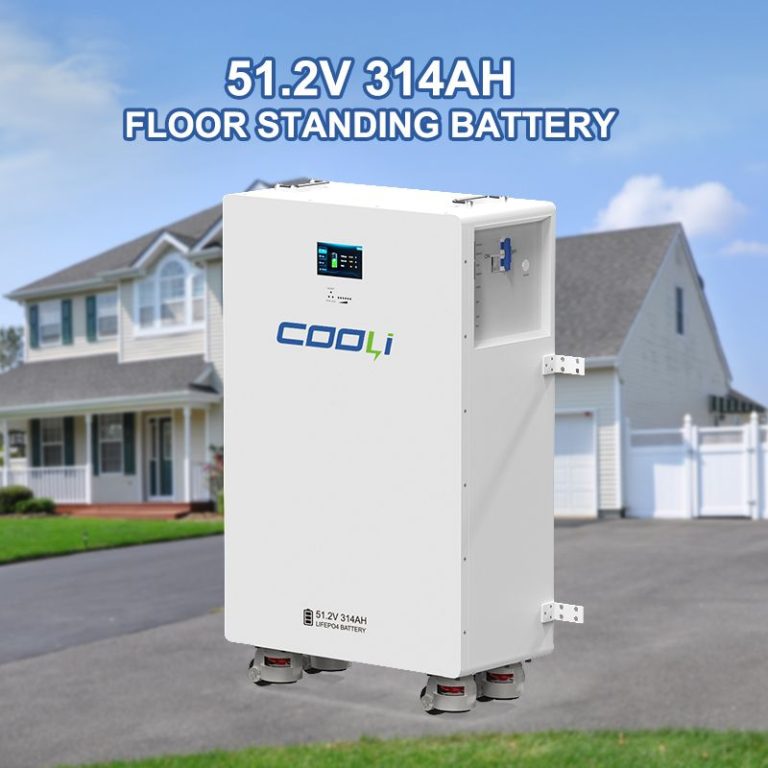
Choosing the right storage for your solar system is one of the most critical decisions you’ll make. The debate of lithium battery vs lead acid battery is central to this choice, impacting everything from your daily usable energy to the long-term financial return on your investment. While the lower upfront cost of lead-acid might be tempting, modern lithium iron phosphate (LiFePO₄) batteries offer a host of advantages that make them the superior choice for most applications .
This guide will compare lithium battery vs lead acid battery across all key metrics—cost, efficiency, lifespan, and maintenance—to help you decide which technology is right for your home, RV, or off-grid project.
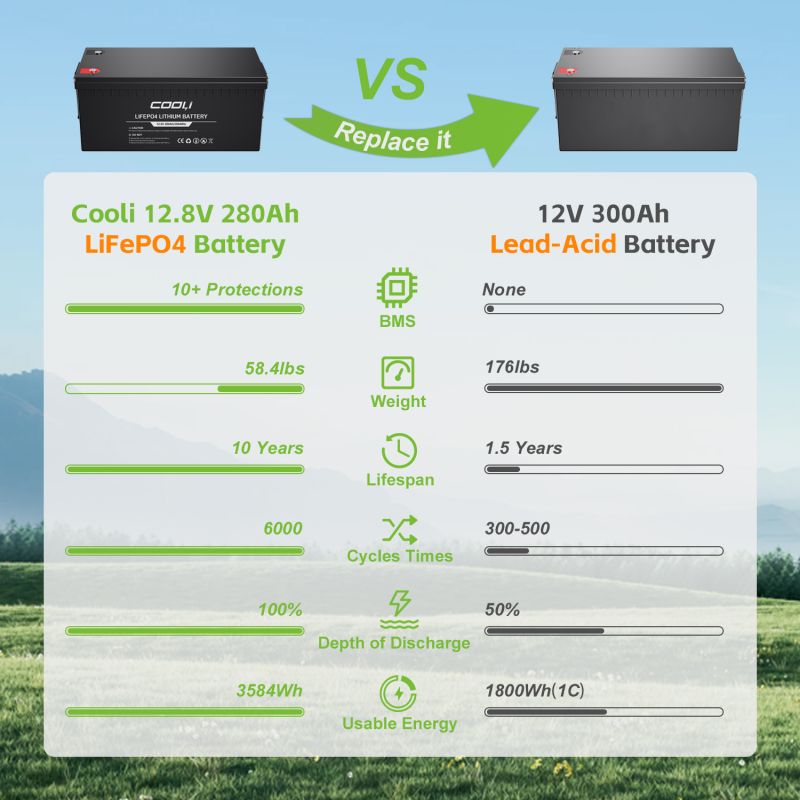
Table of Contents
At a Glance: Key Differences
Before diving into the details, here is a quick overview of how the two technologies stack up in a solar context.
| Feature | Lithium Battery (LiFePO₄) | Lead-Acid Battery (Flooded/AGM) |
|---|---|---|
| Usable Capacity | 80-100% | ~50% |
| Lifespan (Cycles) | 3,000 – 6,000+ | 500 – 1,200 |
| Round-Trip Efficiency | 95-98% | 80-85% |
| Maintenance | None | Regular watering, cleaning (for flooded) |
| Weight | Lightweight | Very Heavy |
| Upfront Cost | Higher | Lower |
| Lifecycle Cost | Lower (better long-term value) | Higher (due to replacements) |
The Capacity Trap: Depth of Discharge (DoD)
The most common pitfall for solar beginners is confusing a battery’s total capacity with its usable capacity. This is where the lithium battery vs lead acid battery comparison begins.
Depth of Discharge (DoD) indicates the percentage of a battery’s energy that can be used without causing permanent damage.
- Lead-Acid: To preserve its lifespan, you should only discharge a lead-acid battery to about 50% of its total capacity. Discharging it further causes sulfation, which rapidly degrades its performance and longevity . This means a “10kWh” lead-acid battery bank effectively provides only 5 كيلو وات/ساعة of usable power.
- Lithium: Lithium batteries, particularly LiFePO₄, can be safely discharged to 80-90% or even 100% without affecting their cycle life . A “10kWh” lithium battery delivers 9-10kWh of usable power.
The Implication: To get the same 10kWh of usable nightly power, you would need to purchase and install a 20kWh lead-acid bank versus a 10kWh lithium bank. This massive size difference often negates lead-acid’s lower upfront price per kilowatt-hour .
Cost Analysis: Upfront Price vs. Long-Term Value
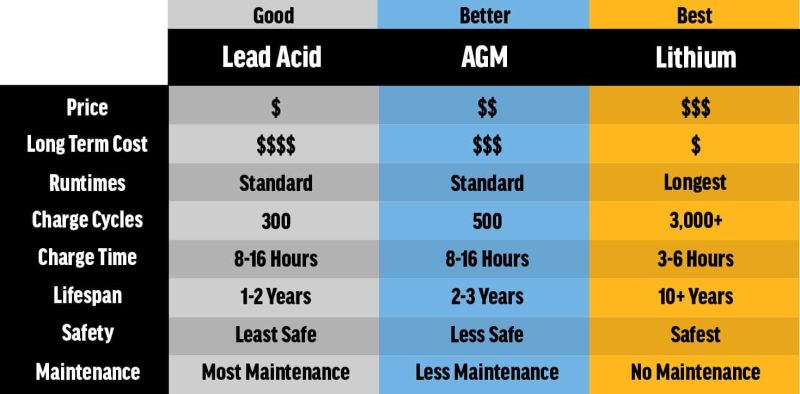
When comparing lithium battery vs lead acid battery, the price tag is the first thing people notice. However, a true cost analysis looks at the Total Cost of Ownership (TCO) over the system’s life.
1. Upfront Investment
- Lead-Acid: Wins on sticker price. It is the cheaper option at the point of sale, making it attractive for budgets that cannot stretch .
- Lithium: Costs 2-3 times more upfront than a comparable lead-acid battery .
2. Lifetime Cost and ROI
This is where the scales tip dramatically in favor of lithium. Because you must replace lead-acid batteries multiple times, the initial savings disappear.
- Replacements: A quality lithium battery can last 10-15 years. A lead-acid battery typically needs replacement every 3-5 years . Over a decade, you might buy one lithium battery but three or four lead-acid banks.
- Cost per Cycle: When you divide the battery cost by the number of cycles it delivers, lithium is far cheaper. One analysis shows lithium costing roughly $0.0045 per watt-hour over its life, compared to $0.01 per watt-hour for lead-acid .
- Labor & Downtime: Each lead-acid replacement involves labor, disposal costs, and system downtime, which adds hidden costs not reflected in the initial price tag .
3. Savings from Efficiency
Lithium’s higher efficiency means you waste less solar energy. Over a decade, these savings can add up to thousands of kilowatt-hours that you don’t have to pull from the grid .
Summary: Choose lead-acid for the lowest possible first cost today. Choose lithium for the best financial return over the next ten years.
Efficiency and Performance
How effectively a battery stores and releases energy is critical for a solar system.
Round-Trip Efficiency
This measures how much energy is lost in the storage process.
- Lithium (LiFePO₄): Boasts an impressive 95-98% round-trip efficiency. For every 10kWh of solar power you put in, you get back over 9.5kWh .
- Lead-Acid: Lags behind with 80-85% efficiency. Up to 20% of your valuable solar energy is lost as heat during the charge and discharge cycle .
Charge Speed
Time is money, and lithium charges much faster.
- Lithium: Can accept a high charge current, often reaching full capacity in 1-3 hours. This is perfect for capturing variable solar energy on partly cloudy days .
- Lead-Acid: Has a slow, multi-stage charge profile that can take 6-8+ hours to fully recharge. It may never reach a full charge on a day with limited sun .
Voltage Stability
- Lithium: Provides a stable voltage output throughout the entire discharge cycle. Your appliances and inverter receive consistent power until the battery is nearly empty .
- Lead-Acid: Voltage steadily drops as the battery discharges. This voltage sag can cause inverters to shut down early, even though there is still energy left in the battery.
Maintenance, Lifespan, and Practicality
Maintenance Requirements
- Lead-Acid: Flooded lead-acid batteries require regular maintenance, including checking water levels, cleaning terminals to prevent corrosion, and performing equalization charges . While sealed AGM types eliminate watering, they are still sensitive to charging parameters.
- Lithium: Lithium batteries are truly maintenance-free. With no fluids to check and a sealed case, you can “set it and forget it” .
Lifespan and Cycle Life
- Lead-Acid: Typically offers 500 to 1,500 cycles, depending on the quality and depth of discharge . Their lifespan is also shortened by partial state-of-charge operation, which is common in solar applications.
- Lithium: A quality LiFePO₄ battery provides 3,000 to 6,000+ cycles . This means it could last for over a decade with daily use, outliving several lead-acid banks .
Weight and Space
- Lead-Acid: Incredibly heavy. A lead-acid bank weighs about 45-50 kg per usable kWh—roughly four times heavier than lithium . This requires reinforced flooring and makes installation difficult.
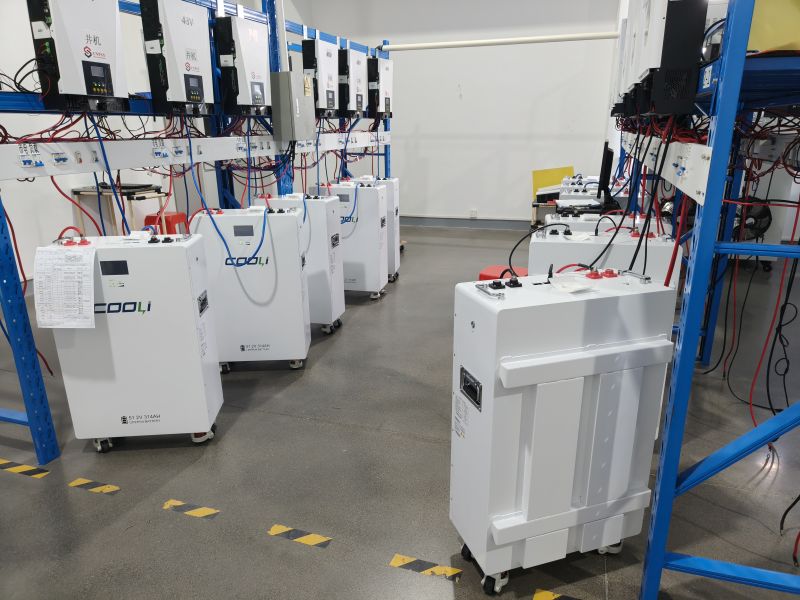
- Lithium: Lightweight and compact. A lithium battery weighs about 12 kg per usable kWh . Their high energy density allows for sleek, wall-mounted installations that save valuable floor space .
Safety
Modern solar systems primarily use LiFePO₄ chemistry, which is one of the safest lithium chemistries available. It is non-combustible and highly resistant to thermal runaway, making it safe for indoor installation .
Which One is Right for Your Solar System?
When to Choose Lithium (LiFePO₄) Batteries
- Daily-Use Solar Systems: For homes, RVs, or boats that rely on solar power every day, lithium’s long cycle life is essential .
- Limited Space: If you have a small garage or want a clean, wall-mounted installation, lithium’s compact size is a major advantage .
- You Want “Set and Forget”: If you prefer to avoid the hassle of regular battery maintenance, lithium is the clear winner.
- Cold Weather (with caution): While lithium cannot be charged below freezing (32°F / 0°C) unless it has an internal heater, its discharge performance in cold is excellent .
When to Choose Lead-Acid Batteries
- Extreme Budget Constraints: If you simply cannot afford the higher upfront cost of lithium.
- Infrequent, Standby Use: For a backup system that is rarely cycled (e.g., a weekend cabin), the shorter lifespan of lead-acid is less of an issue .
- Very High Temperature Environments: In consistently hot climates without climate control, lead-acid can be more forgiving than lithium, though both degrade in heat .
Installation and Compatibility Considerations
Making the switch to—or choosing—a new battery also involves ensuring it works with your existing gear.
Inverter/Charge Controller Settings: Lead-acid and lithium batteries have different charging profiles. If you are replacing lead-acid with lithium, your inverter and charge controller must be reprogrammed to the correct voltage set points for LiFePO₄ chemistry. Using a lead-acid charger on a lithium battery will prevent it from fully charging .
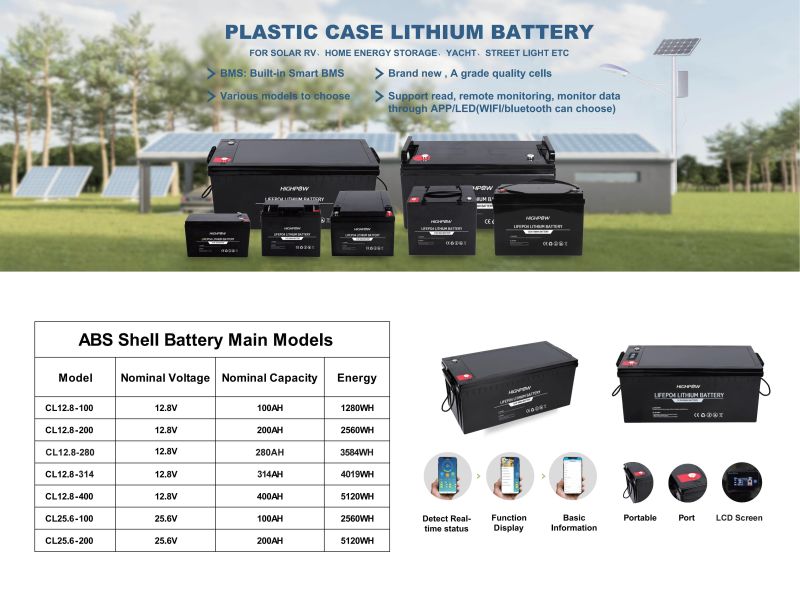
Battery Management System (BMS): All modern lithium batteries include an internal BMS. This computer manages the cells, protects against over-charging and over-discharging, and balances the battery pack. For best performance, look for a system with “closed-loop” communication, where the inverter and battery BMS talk to each other directly .
Location: Whether you choose lithium or lead-acid, the installation location matters. It should be cool, dry, and well-ventilated. Many modern lithium systems are rated for outdoor installation (with appropriate weatherproofing like IP65), but always check the manufacturer’s specifications .
Final Verdict
In the great debate of lithium battery vs lead acid battery for solar, the evidence is overwhelming. While lead-acid batteries remain a viable option for low-budget, low-use scenarios like weekend cabins, lithium iron phosphate (LiFePO₄) is the superior technology for most modern applications.
Its higher efficiency, deeper usable capacity, zero maintenance, and dramatically longer lifespan mean that despite the higher upfront cost, a lithium battery saves you money and delivers a better experience over the long term. It turns your solar system from a simple backup into a high-performance, reliable, and hands-free power solution for your home or mobile lifestyle.